
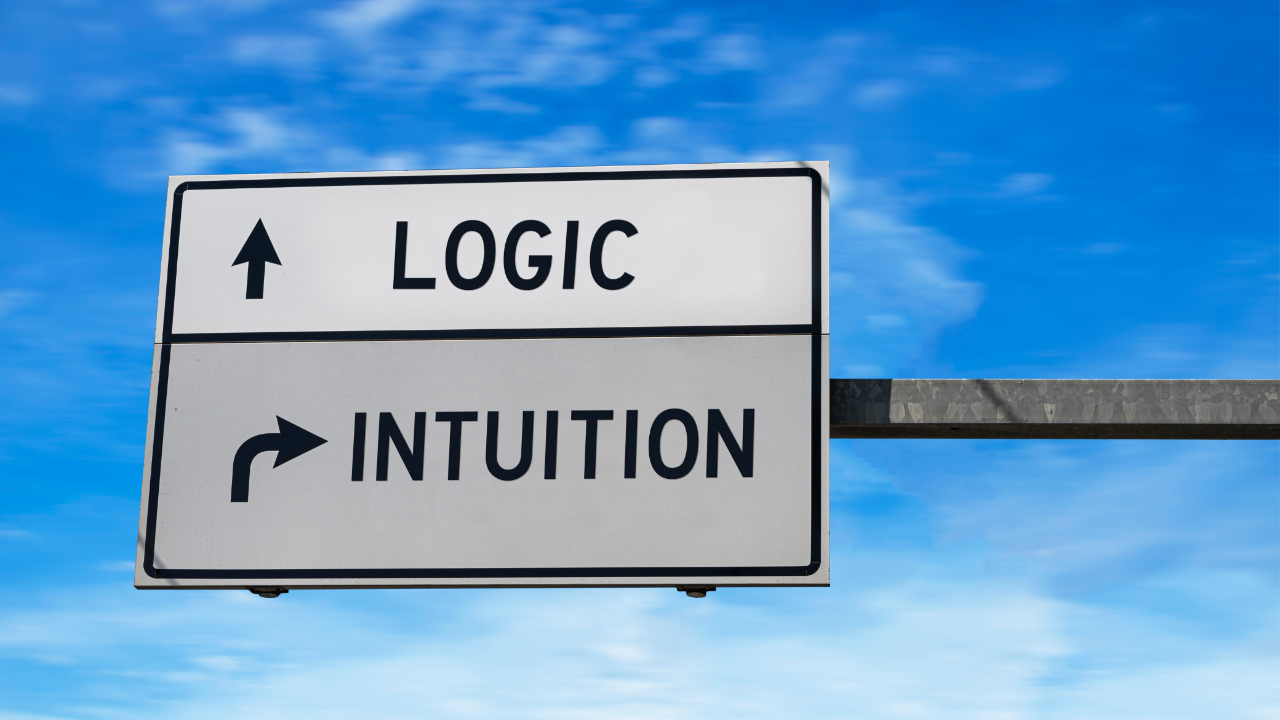
Can you use your gut feeling to make decisions?
Apr 26, 2026
Have you ever made a decision where your brain was telling you one thing, but your gut was telling you something else?
Maybe you were deciding to take a new role you were scared of, or saying yes to a project you didn’t really want.
I’ve been there.
A few years ago, I was deciding between two job offers. Should I stay at my company, or take a new opportunity? I went back and fourth for weeks, listing pros and cons. In the end, I went with my gut and took the new role.
A few months later, I bumped into a former colleague. She told me my old company had gone downhill - the culture had changed and people were leaving. I’d dodged a bullet.
But there have also been times I ignored my gut completely.
When I started my business, I had coffee chats with people who wanted to collaborate. Sometimes my gut would quietly say “don’t work with this person.” But my brain would jump in: “They might bring you business. Why not just have a chat?”
So I’d go ahead. And many times, it led nowhere.
The conversation that changed how I think about gut feeling
I never connected the dots until last week, when I had a conversation with other senior women leaders at a workshop on the topic of saying no.
We talked about how you actually know when to say no to something, as many of us take on too much.
Then we did a simple exercise. We connected to our breath, slowed it down, and noticed how our body felt about a choice we were considering.
I was surprised by how strong the reaction in my body was. Before my brain had even started thinking about it, my body had an answer.
The other women in the room said the same thing. The gut feeling is hugely valuable when you’re deciding what’s right for you. And it often knows the answer before your brain has caught up.
When I got home, I got curious. Why does the gut know things the brain doesn’t? Where does this feeling actually come from? And when should you trust it?
What the gut feeling actually is
Your body takes in information much faster than your brain can think about it.
Daniel Kahneman explained this in his book “Thinking, Fast and Slow.” He describes two ways our minds work.
System 1 is fast and automatic. It uses shortcuts your brain has built over time. You don’t have to think about 1 + 1 = 2 or about how to drive on a familiar road. And if you see a snake in the grass, you jump before you’ve even processed what you saw.
System 2 is slow and deliberate. It’s the part you use when you calculate 16 x 17 in your head. Or compare two mortgage offers.
The gut feeling is linked to System 1.
One important note: System 1 contains real wisdom, but it also contains lazy bias.
How this works in your body
There’s a part of your brain called the vmPFC (ventromedial prefrontal cortex). It stores your past experiences, including how you felt during them. When you face a new decision, it pulls up those old experiences and creates small physical reactions - a faster heartbeat, tighter shoulders, a feeling in your stomach. Scientists call these “somatic markers”.
For example: Feeling a knot in your stomach when a particular project gets mentioned, or noticing your shoulders relaxing when you imagine taking the new role. That’s your body giving you data.
This all happens before your conscious mind has even started thinking. Which is why gut feelings feel so emotional - because they are.
From an evolutionary point of view, this is brilliant. When a situation is complex, your body gives you a quick nudge in the right direction. You don’t have time to analyse the snake, you just need to move.
There’s also something called the “gut brain.” It’s a second nervous system in your stomach that talks to your main brain. Research shows your gut bacteria can actually affect your mood and your decisions. Your gut isn’t just a metaphor - it’s literally communicating with you.
So here’s the summary: your mind is constantly picking up signals you’re not consciously aware of. The only way to access that information is through your gut feeling.
Does the science back this up?
Yes. People who can tap into their gut feelings make better decisions.
The most striking proof comes from a researcher called Antonio Damasio at the University of Iowa. He studied patients with damage to the vmPFC - the part of the brain that creates somatic markers. These patients were perfectly intelligent. But they couldn’t make good decisions.
There’s a story he tells about one of these patients. Damasio asked him to choose between two dates for his next appointment. The man pulled out his diary and began listing reasons for and against each date - his other commitments, the weather, how close one date was to another. After half an hour of perfectly logical analysis, the man still hadn’t decided. Damasio had to choose for him.
Without the gut feeling, pure logic gets stuck.
But should you really use this at work?
This is the part that’s tricky. We’re told to be logical, data-driven, especially in science, tech, and engineering. For years, I leaned toward suppressing my intuition because it felt too emotional, not rational enough for the technical world I worked in.
I know many women who have had the same experience. You’ve been told - directly or indirectly - to suppress that part of yourself.
But here’s what the research actually shows.
Management studies find that executives routinely use their intuition to solve complex problems where logic alone won’t work. The higher up the ladder you go, the more your gut matters. Intuition is one of the things that separates good leaders from great ones.
There’s a famous example from the 1990s. The Chrysler CEO decided to launch the Viper, a sports car many critics condemned. He went ahead because it felt right - and he was correct. (HBR has a great article on this called “When to Trust Your Gut” if you want to read more - I have linked it below)
Why does this work? Because gut feelings in business are an accumulation of all your experience. The more years you’ve worked, the more patterns you’ve seen, the better your gut gets at recognising them.
Top executives don’t just rely on their gut blindly though. They use it as a strong signal, then build in a self-checking mechanism - they revisit the decision later and adjust.
The skill you need to develop is “intuitive intelligence”. Knowing when to trust your gut, and when not to.
When to trust your gut, and when not to
This is the part that matters most, especially for women who’ve been told to suppress this signal for years.
Trust your gut when:
-
You have deep experience in the area and your gut has real data to work with.
-
The decision is about what’s right for you personally. Your body knows what fits you better than any spreadsheet.
-
The data is incomplete and you can’t analyse your way to an answer.
Be cautious when:
-
The feeling matches a familiar fear pattern. If the voice is saying “I can’t do this, I’m not ready, who am I to ask for this” - that’s often conditioning, not intuition. Real intuition tends to feel like you know something, you don’t panic.
-
You’re tired or stressed. You cannot feel your gut clearly when you are low on energy.
-
You have no experience to draw on. Your gut isn’t useful in territory it’s never seen before.
How to actually tap into it
You need to get your brain into the right state to hear what your gut is saying. The logical thinking has to quiet down.
Some people run, swim or meditate. Anything that calms the noisy part of your mind will help.
The easiest way to do this right now, in the next minute, is using the “calming breath technique”:
-
Breathe in for 6 seconds.
-
Hold for 2 seconds.
-
Breathe out for 7 seconds.
-
Repeat 4 times. That’s about a minute.
Then ask yourself the question. Notice what your body does.
If you like such quick practical tools - you can find more in my book “The 5 Keys To Your Potential - an actionable guide for women in STEM”, publishing at the end of May. Read more here & join the virtual launch.
The other thing that helps is building self-awareness over time. Research shows that people with strong introspection skills can detect their gut feeling more easily - and then can decide, with a clear head, whether to trust it.
One last thing
In a world where AI can out-analyse us on data, your gut is becoming more valuable, not less. AI can’t read the room. It can’t tell you what’s right for you. That’s still your job - and it’s the part of the work no one else can do for you.
PS. The Harvard article “When to Trust Your Gut” is linked here: https://hbr.org/2001/02/when-to-trust-your-gut